



Rolling bearings are precision machine elements found in a wide variety of applications. They are typically reliable even under the toughest conditions. Under normal operating conditions, bearings have a substantial service life, which is expressed as either a period of time or as the total number of rotations before the rolling elements or inner and outer ring fatigue or fail. Less than 1 percent (0.35 percent specifically-see Figure 1) of rolling bearings do not reach their expected life. (Source: FAG Bearing Antriebtechnik 18 from 1979.)
Premature Bearing Failure
When a bearing does fail prematurely, it is usually due to causes that could have been avoided. For this reason, the possibility of reaching conclusions about the cause of a defect by means of studying its appearance is useful. It is most important to correct the causes and prevent future failures and the costs that follow.
Most bearing failures such as flaking and pitting, spalling, unusual wear patterns, rust and corrosion, creeping, skewing and others are usually attributed to a relatively small group of causes that are often interrelated and correctable. These causes include lubrication, mounting, operational stress and bearing selection and environmental influence.
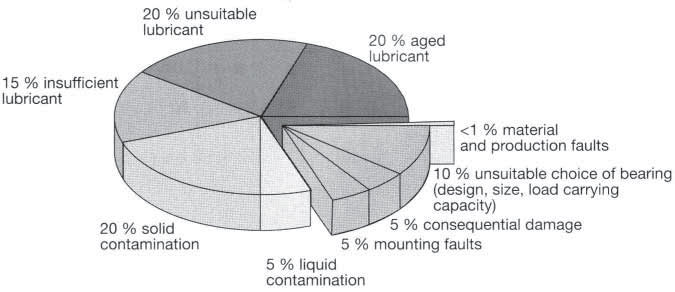 |
| Figure 1. Causes of failure in rolling bearings |
Proper/Improper Lubrication and "Grease Service Life"
The purpose of lubricating the bearing is to cover the rolling and sliding contact surfaces with a thin oil film to avoid direct metal to metal contact. When done effectively it:
1. Reduces friction and abrasion
2. Transports heat generated by friction
3. Prolongs service life
4. Prevents rust and corrosion
5. Excludes foreign objects and contamination from rolling elements
Grease is generally used for lubricating bearings because it is easy to handle and simplifies the sealing system, while oil lubrication is generally suitable for high speed or high temperature operations.
Generally lubrication failures occur due to:
1. The wrong lubricant type
2. Too little grease/oil
3. Too much grease/oil
4. Mixing of grease/oil
5. Contamination of the grease/oil by objects or water
In addition to considering normal bearing service life, normal grease service life is important to consider since together they maximize bearing life. Grease service life is the time during which proper bearing function is sustained by a particular quantity and category of grease. This is especially critical in pump, compressor, motor and super precision applications.
Mounting and Installation of Bearings
It is critical in the mounting and installation process to pay strict attention to:
1. Use of proper tools and ovens/induction heaters. Use a sleeve to impact the entire inner ring face of the ring that is being press fit.
2. Verify the shaft and housing tolerances. If the fit is too tight, too much preload is created. If the fit is too loose, too little resulting preload may allow the shaft to rotate or creep in the bearing. Check for proper diameters, roundness and chamfer radius.
3. Avoid misalignment or shaft deflection. This is especially critical in mounting bearings that have separable components such as cylindrical roller bearings where successful load bearing and optimal life are established or diminished at installation.
4. Be aware of radial internal clearance (see Figure 2). It is critical to maintain the proper RIC established in the original design. The standard scale in order of ascending clearance is C2, C0, C3, C4, C5. The proper clearance for the application is critical in that it allows for the challenges of:
- Lubrication. A proper film of lubricant must be established between the rolling elements. Reducing internal clearance and impeding lubricant flow can lead to premature failure.
- Shaft fit. A reduction in the radial internal clearance is inevitable when the bearing is press fit.
- Heat. In normal bearing operation, heat is produced that creates thermal expansion of the inner and outer rings. This can reduce the internal clearance, which will reduce the optimal bearing life.
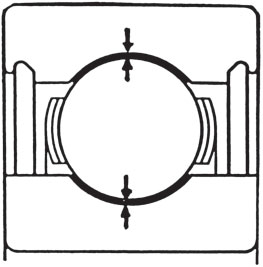 |
| Figure 2. Radial internal clearance. |
Operational Stress and Bearing Selection
It is generally the exception to find a bearing that has been improperly designed into an application. However, factors within the larger application may change.
If loads become too high, overloading and early fatigue may follow. If they are too low, skidding and improper loading of the rolling elements occur. Early failure will follow in each situation. Similar issues arise with improper internal clearance.
The first sign of these issues will be unusual noises and/or increased temperatures.
- Increased temperature. Bearing temperature generally rises with start-up and stabilizes at a temperature slightly lower than at start up (normally 10 to 40 deg C higher than room temperature). A desirable bearing temperature is below 100 deg C.
- Noises. Abnormal bearing sounds typically indicate certain issues in the bearing application. While this is a subjective test, it is helpful to know that a screech or howl sound generally indicates too large an internal clearance or poor lubrication on a cylindrical roller bearing while a crunching felt when the shaft is rotated by hand usually indicates contamination of the raceways. See Table 1.
Operational stresses in the applications can impact bearing life as well. It is critical to isolate vibrations in associated equipment as they can cause uneven running and unusual noises.
| Sound | Other Indicators | Causes |
| Hiss | Small Bearings | Raceway, ball or roller surfaces are rough |
| Buzz to Roar | Loudness and pitch change with speed | Resonation; poor fit; bearing rings deformed; vibration of raceways, balls or rollers; brinelling |
| Crunch | Felt when bearing is rotated by hand | Scoring of raceway surfaces; scoring of balls or rollers; dust/contamination |
| Hum | Disappears when power supply is shut off | Electromagnetic sound of motor |
| Clatter | Notieable at low speeds, continous at high speeds | Bumping in cage pockets due to insufficient lubricant |
| Screech/Howl |
Occurs mainly on cylindrical roller bearings; Sound changes with speed. Goes away temporarily with lubrication.
Table 1
Click here to download a PDF of the Table 1.
Environmental Influence
Even with the best design, lubrication and installation failures will occur if the operating environment is not considered. While many potential issues exist, the primary ones are:
1. Dust and dirt that can aggressively contaminate a bearing. Great care should be given to use proper sealing techniques.
2. Aggressive media or water. Once again, sealing is primary. The use of specialty type seals is recommended such as pump mechanical or labyrinth style seals that do not score the shaft.
3. External heat. The ambient operating temperature mandates many choices in radial internal clearance, high temperature lubricants, intermittent or continuous running and others that affect bearing life.
4. Current passage or electrolytic corrosion. If current is allowed to flow through the rolling elements, sparks can create pitting or fluting on the bearing surfaces. This should be corrected by creating a bypass circuit for the current or through the use of insulation on or within the bearing. This should be an inherent design consideration in applications such as wind turbines and all power generating equipment.
In conclusion, the first step in the overall prevention of bearing failure lies in the consideration of bearing technologies most suitable to the application with regard to specifications, recommendations, maintenance strategies, fatigue life and wear resistance of the bearing in relation to the application. That being said, premature bearing failure within a proper application is typically attributed to one or more of the causes discussed (lubrication, mounting, operational stress and bearing selection or environmental influence) and can and should be corrected to avoid future bearing failures and additional cost.
Sources
- Barden Corporation. Machine Tool Technical Bulletin for Engineering and Lubrication. 2010.
- FAG Bearings Corp. Rolling Bearing Damage. Publ. No. WL 82 102/2 December 1997.
- Fersa Bearings. Roller Bearings: Failure Diagnosis. 2009.
- Koyo Bearing Corp. Rolling Bearings: Failures, Causes and Countermeasures. Catalog No. 322E. December 1995.
- NTN Bearing Corp. Products and Technology. Care and Maintenance of Bearings. 2009.
Pumps & Systems, May 2010