




For controller-to-controller coordination, wireless Bluetooth is an excellent alternative to Class 3 radios.
Developed by the Bluetooth Special Interest Group (SIG), a not-for-profit trade association, Bluetooth® wireless technology was created as a short-range coordination technology. Its goal was to replace the cables that connect portable and fixed devices while maintaining high levels of security. SIG sought to develop some key design features for the technology including:
- Robustness
- Low power
- Low cost
Radio Classifications
Cell phone ear buds are the most common Bluetooth devices. One may wonder how this same technology that is power optimized and communicates over short distances could be used in an industrial setting. In these environments, a high-powered radio is required to cover longer distances and pass through, or around, plant equipment and walls.
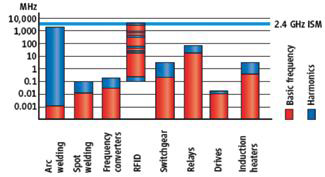
Figure 1 (below). A typical interfernece generated by equipment commonly found in industrial applications. The 2.4 GHz band is higher than most interference produced by operating equipment, making it an ideal frequency for industrial applications.
 Three different classes of radios are available for use in industrial settings.
Class 3 radios have a range of up to 1 meter or 3 feet.
Class 2 radios are ubiquitous to mobile devices and have a range of 10 meters or 33 feet.
Class 1 radios are primarily used for industrial applications and have a range of 100 meters or 300 feet.
Many consumer devices use a Class 3 radio for communicating short distances. This technology is well-suited for devices such as wireless ear buds since the signals only need to travel a few feet and require very little power. A higher-powered device is needed for industrial control classes.
Depending on the application, a Class 1 or 2 radio would be the best choice for industrial control applications. In most applications, controllers are supplied with ample power. So, power optimization is not a top consideration.
Operating Frequency
Wireless Bluetooth devices operate in the unlicensed 2.4 GHz ISM frequency band. Set aside for industrial, scientific and medical (ISM) devices, the band is available for use in most countries. Its high frequency makes it ideal for industrial communications. Equipment operating on plant floors generates base frequencies that could interfere with wireless communications. However, they will likely operate at lower frequencies.
Frequency Hopping
The Bluetooth system operates in the frequency band from 2,400MHz to 2,483.5 MHz. This band is divided into 79 radio frequency (RF) channels and is ordered from 0 to78. The RF channels are spaced 1 MHz apart beginning at 2,402 MHz. This high bandwidth is another benefit resulting from the use of the license-free ISM band.
Devices communicating on a Bluetooth network use a specific frequency hopping pattern that is algorithmically determined by the Bluetooth specification. The basic hopping pattern is a pseudo-random ordering of the 79 frequencies. This pattern can be adapted to exclude a portion of the frequencies used by other devices on the ISM band, such as Wi-Fi. This hopping technique improves Bluetooth device coexistence with static ISM systems when within the same facility.
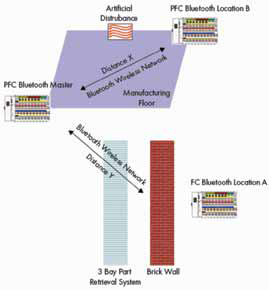 |
| Figure 2. Test system layout |
Security
Security is another consideration for industrial wireless data transfer. Can someone jam or manipulate the data that is being transferred? The Bluetooth SIG team emphasized security from the inception of the standard. With more than 8,000 global members, the SIG's Security Expert Group is made up of wireless security experts.
The Bluetooth 2.0 + EDR standard also specifies three security levels, enabling developers to select the optimum security level for their Bluetooth-equipped product. The three levels stated in the specification are:
- Security Mode 1: non-secure
- Security Mode 2: service level enforced security
- Security Mode 3: link level enforced security
The lower security levels are intended for simple devices, such as ear buds. These types of devices do not typically have hardware-like displays or user interfaces, preventing in-depth security set up. Industrial control applications should employ the highest levels of security possible. Industrial controllers commonly use PCs with sophisticated software for configuration and code development, allowing for higher-level security configurations. One option that needs to be used is the pairing of devices. Control engineers need to have the ability to pre-configure what devices are allowed to communicate on the Bluetooth network. This is accomplished by pairing devices with their Media Access Control (MAC) IDs. If an attacking device enters the network, it will not be allowed to communicate on the network as its MAC ID is not recognized.
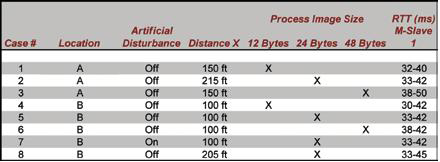 |
| Figure 3. Case results |
Encryption must also be employed in wireless industrial controller-to-controller coordination. From debit cards to cell phone voicemail access, the majority of consumer electronics use PIN codes (usually four digits). However, a study has shown that a typical PC can decipher a four-digit pin in less than one second. The longer the PIN, the more difficult it is to “crack.” It is estimated that an eight-digit pin could take up to 100 years to decipher using current PCs and modern algorithms.
The Bluetooth 2.0 + EDR specification enables manufacturers to use a much longer PIN, providing much more randomness. This specification allows for a 16-character alphanumeric, case-sensitive PIN, which yields about 95 bits of entropy. This technology is Secure Simple Pairing in the Bluetooth specification.
Technology Test
A Bluetooth RF transceiver module was manufactured for use in an industrial setting. The producer tested the tranceiver in a manufacturing environment. This test was conducted at the manufacturer's North American headquarters. The goal of the testing was to gauge the performance of two Bluetooth modules and measure the communication times between the two modules in different circumstances within a manufacturing environment. Factors included distance, interference and number of communicating devices.
The Setup
Identical nodes were used in the testing to simulate controller-to-controller coordination. Each node contained an Ethernet TCP/IP programmable Fieldbus controller, a digital input and output module and the Bluetooth module.
For the test, Slave 1 was placed in the plant's utility room—where a source of electrical noise could be activated—with Master 1 in open areas at varying distances away. Later, Slave 1 was relocated across the plant floor behind a wall near an automated parts retrieval system. After these trials, Slave 1 was placed in an office area behind an elevator and the test program was repeated. See Figures 2 and 4
Round Trip Time Program
A program was created to measure the efficiency of the Bluetooth modules. It measured the length of time taken to transmit data from the master to the slave and then receive it back.
For each slave, the master sent out the system time at the start of transmission. Meanwhile, the slave continuously returned the same process image that it received. The master watched these incoming packets, and when it detected the time value equivalent to the one it sent out, it recorded the new system time. The round trip time was calculated from the difference between the two system times.
Signal Strength
The capability of measuring the Bluetooth signal strength was available through the Bluetooth module's configuration software. Nominal signal strength registered at 0 dB. Typical values ranged from 0 to 4dB. During tests, that weakened the signal because of long distance and obstructions, values between 8 dB and 15 dB were observed but did not have a debilitating effect on the system. The most influential aspect of this value was clearly the distance between the nodes.
Bit Error Rate
The bit error rate signifies what percentage of transmitted data was lost due to interference or corrupted packets. These diagnostics were also provided via the Bluetooth module configuration software. When packets are lost, they are retransmitted, thereby increasing the round trip time. Findings showed that the process image size (and therefore packet size) of the Bluetooth module and certain obstructions had the greatest effect on this.
Sources of Interference
Overall, the Bluetooth modules with attached antennae appeared adequately resilient to noise and other sources of interference. A variety of attempts were made to degrade the signal under otherwise normal operating conditions, but in each case, the transmission remained reliable. These attempts and sources included an industrial compressor, a two-cycle gas engine and a variable frequency drive (VFD). The only scenario in which data became difficult to receive involved several walls, an elevator and a fair distance between the two nodes. In that test, the signal strength was greater than 20 dB, and the bit error rate exceeded 25 percent. Further testing for the exact cause was inconclusive.
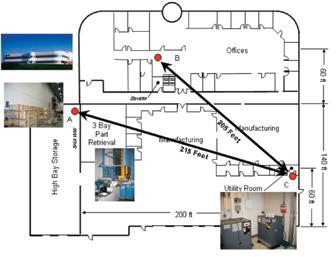 |
| Figure 4. Node locations |
Applications
While the use of Bluetooth technology is new to the industry, it has been implemented in real-world applications in Europe and in the U.S. In Europe, it is currently being used in a water/wastewater treatment plant. In this application it is used to transmit data from far-flung components where cabling is difficult and/or too costly.
In the U.S., a bearing manufacturer is using the technology to display uptime/downtime key performance indicators in its forging plant presses. The data is displayed on a corporate webpage.
Conclusion
From application use and testing, Bluetooth technology has proven to be well-suited for controller-to-controller coordination in an industrial environment. This technology offers an option for a powerful radio that can communicate within a building up to 100 meters or 328 feet. The 2.0 + EDR specification incorporates sophisticated security methodologies to keep data and operations secure. The selection of the 2.4GHz band enables its use globally and is higher than interference frequencies typically generated by industrial control equipment. With frequency hopping, Bluetooth can coexist with other systems that use the ISM band, such as Wi-Fi.
Reference:
Bluetooth SIG.
Bluetooth Specification Version 2.1. EDR volume pp. 57-60.
Coexistence of Wireless System In Automation Technology – Explanations on reliable parallel operation of wireless radio solutions, ZVEI – German Electrical and Electronic Manufactures' Association .
Pumps & Systems, May 2011