






Understanding coating manufacturers' specification sheets.
Choosing a coating for a pump can be a challenging task. A good coating can extend the life cycle of a pump, providing cost and downtime reductions. Alternatively, a poor coating can do the opposite. It could jeopardize the pump and increase costs and downtime.
Information for comparing the coating options is generally limited to three possible sources: anecdotal evidence, a salesman pitch or a manufacturers’ specification sheets. The first two can be judged by impression or level of trust and are somewhat subjective. The third is possibly the most misunderstood and difficult to judge. This article provides insight into the general makeup and applicability of the typical manufacturer’s coating specification in hopes of making the decision easier and increasing the odds of choosing what is best for each pump.
Standards
Most reputable coating manufacturers carry out their performance testing as per industry recognized testing standards. Standards have one purpose, to make a test as repeatable as possible. It does not guarantee that the results have real world meaning, although many make an attempt at doing so. This is important to understand when choosing a material based on a specification sheet.
A common mistake is to compare values side-by-side and make the assumption that the higher the better. Without a basic understanding of the true meaning of the numbers, an objective comparison is impossible. End users must resist the basic human instinct to compare the quick and obvious number and make a swift judgment when, in reality, the not so obvious is many times more meaningful and rarely represented by a single numerical value.
Reading the standard itself offers much insight. Never take the number simply for what it is and understand that not all standards are created equal. Some are specific and detailed while others might be broad with wiggle room. Some standards are also much more representative of desirable properties for a specific application. For example, compressive strength is a value, which for a pump coating application, does not have much significance. However, for a machine shop floor coating with heavy machinery and traffic, it could be more relevant.
 General Data
When analyzing a product specification sheet, keep in mind that thousands of possible tests could be listed for a polymeric coating. What is listed is, therefore, carefully chosen by the manufacturer for a specific reason. Perhaps the manufacturer feels that the data is important for a specific market that it is targeting. Maybe it is limited by testing capabilities, but it could also be limited to the strong points only of the product and intended to make the best impression possible.
Regardless of the reason or intent, what matters is that the end user identifies the data that is most critical to the success of the application. If dealing with coatings that will see chemicals, end users should focus on chemical testing, and identify how the products are tested and how rigorous the testing procedures are. If the pump moves fluid with entrained solids, then abrasion resistance and heat distortion temperature are absolutely critical.
Some basic data that should be present on a specification sheet are:
Physical properties—density, appearance, consistency, viscosity, slump resistance, peak exotherm, time to peak exotherm, working life, percent solids and shelf life. The more details the better because these physical properties allow for proper application planning.
Strength and hardness—compressive strength, flexural strength, tensile strength and hardness are values that could be considered performance data but because they are so generic in nature, they seldom become a critical focal point during coating selection.
Polymer materials could also be formulated in ways that amplify these basic mechanical characteristics but serve little purpose as far as performance in the intended environment or in some cases could be detrimental to the coatings real world performance.
Performance Data
At a minimum, the general performance data in this section should be present in a manufacturer’s coating specification sheet.
Adhesion
Cross hatch for thin coatings, direct tension and lap shear adhesion for thick coatings. Adhesion is critical to the success of any coating. A coating that is unable to maintain a tight bond with the substrate stands little chance of successfully protecting that substrate. Adhesion of coatings is highly dependent on methods of surface preparation.
Some coatings are designed specifically to adhere to poorly prepared or contaminated surfaces. If your application has restrictions on surface preparations, these are important characteristics that could benefit your application. Such coatings should have appropriate data to prove the claims.
Dry Heat Resistance
The thermal stability of a coating is dependent on the formulation of the resin systems. Heat resistance is generally subdivided into dry heat resistance and wet (immersion) heat resistance. The temperature at which a coating will begin to break down is defined as the dry heat resistance of the material. Exposures to temperatures above this value will cause permanent irreversible damage to the coating eventually leading to its destruction.
Immersion Heat Resistance
Immersion heat resistance is almost always lower than dry heat resistance. When immersed in a liquid, a polymeric coating will generally experience a lower heat resistance due to increased permeation of the liquid as the temperature increases. The permeation can lead to blistering, chemical attack, under coating corrosion and other detrimental effects. Coatings chosen for immersion service should be tested by a rigorous method to determine the immersion heat resistance.
Atlas cell testing is among the most widely accepted and most scrupulous methods available. Atlas cell testing will not only expose the coating to the hot fluid but also incorporates the effects of a cold wall. A cold wall will make conditions much more aggressive to the coating by introducing a strong thermal gradient across the coating. The strength of the cold wall depends on the thickness of the coated metal panel. Thicker panels will dampen the cold wall effect since they will contain a larger thermal mass.
Heat Distortion Temperature
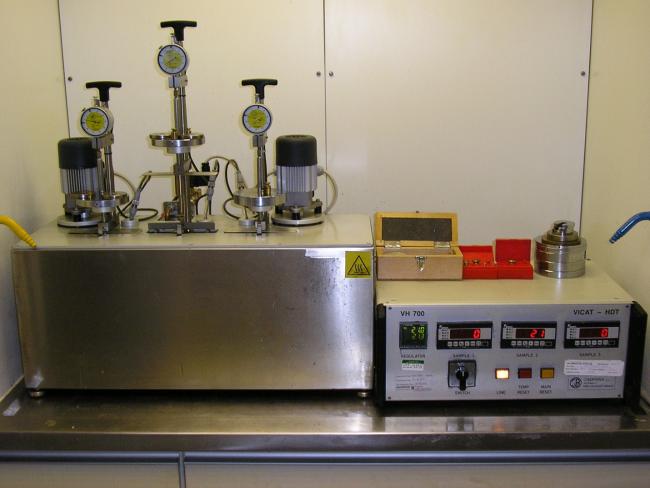
The heat distortion temperature of a material defines a temperature at which the material begins to soften. When a material exceeds its heat distortion temperature, it will lose most of its physical strength and soften. It is important to note that this is not a permanent effect. Once the temperature has decreased below the heat distortion temperature, the material will regain its rigidity, returning to normal.
The heat distortion temperature is extremely important in situations and meaningless in others. Any coating that will be subject to mechanical stress or chemical exposure should never be put in service above its heat distortion temperature. For pumps, I this is a critical property since high velocity fluids and possible abrasion are the norm.
Abrasion Resistance
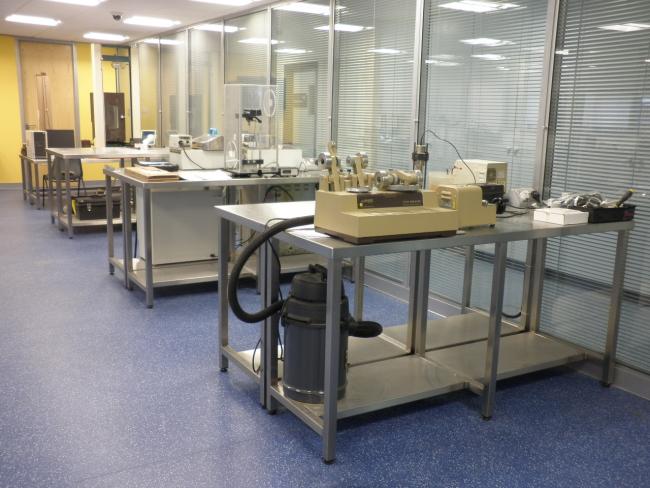
Abrasion is difficult to simulate and generalize in a test due to the nature of the effect. Abrasion of a coating can occur by different means such as fluid impingement, impact abrasion and erosion by entrained solids. Sliding abrasion is often tested by the Taber method in which abrasive wheels slide over a rotating sample for a given number of cycles. The mass loss is then determined. This method is effective for comparing sliding abrasion of coatings. Several parameters need to be established and quoted along with the results.
When using Taber abrasion for comparison of coatings, all these parameters need to be the same. The parameters are mass of weights, wheel used, number of cycles and abrasive condition (wet or dry). Only when all these are the same can two test results be compared side by side. Taber results are determined by measuring the mass of the sample before and after the test. The mass loss represents the degree of abrasion.
Considering the density of the coating when comparing values is important. Because coatings have different densities, mass alone is a poor tool for comparison. Many coatings manufacturers will convert mass loss to volume loss. However, one should never compare different material by mass loss. Comparison by volume is the only accurate way to compare two coating’s abrasion resistance. A gram of coating A does not necessarily equate a gram of coating B if their densities are different. A cubic millimeter of coating A and a cubic millimeter of coating B will always be the same quantity. After all, the interest is in how quickly the coating will wear down not how much mass is being lost as it wears.
Cathodic Disbondment
Coatings that will work alongside cathodic protection systems should be tested for cathodic disbondment resistance. The presence of a polarizing potential on exposed sections of a cathode will produce an aggressive environment for a coating, which could lead to disbondment and corrosion creep.
Corrosion Resistance
Accelerated corrosion testing generally performed in a salt spray cabinet to demonstrate the coatings ability to provide protection in corrosive environments reveals how well the coating withstands this effect.
Accelerated Weathering
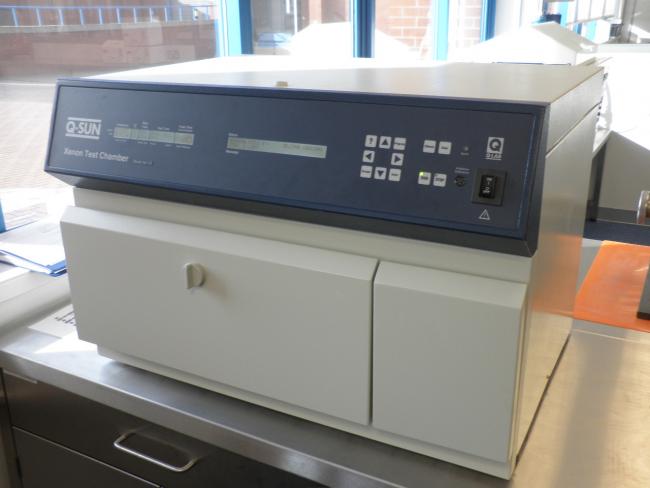
Testing for discoloration, loss of gloss, blistering, flaking, rusting or other break down when exposed to harsh environments. This test can be performed in a test chamber designed to simulate such environments or in outdoor exposures.
Outdoor exposure should be in geographical areas of harsh weather conditions such as Florida or Arizona.
Key Steps
As this article shows, choosing a pump coating is no easy feat. It consists of several steps in which the decision maker must have extensive knowledge of the structure or equipment that will be coated, as well as the coatings themselves. Otherwise, a significant number of coating failures can result.
The key steps to choosing the right coating is first to understand what key properties are required of the coating.
Once this is accomplished, end users can start looking at specifications sheets to determine if the standards quoted accurately simulate the expected real-world conditions.
This should lead to an educated and correct decision. In essence, a properly chosen coating will prolong pump life by repairing it, reduce downtime by protecting it and possibly even improve its efficiency.
Pumps & Systems, February 2012