




Improvement can result from repair opportunities.
Often all that is needed to improve a pump’s dependability and performance is a high quality inspection and repair. Over time, a pump may have been repaired by more than one service provider with varying levels of engineering and technical experience.
Tolerances may have been opened, fits and concentricities may have been lost and materials may have been changed, all of which contribute to reduced performance, loss of reliability and more frequent repairs.than one service provider with varying levels of engineering and technical experience.
This article highlights the opportunity seized by a coal-fired power generating facility located in Western Pennsylvania, to upgrade a Westinghouse vertical pump.
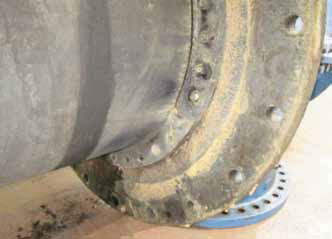 |
| Column pipe upper flange as-received |
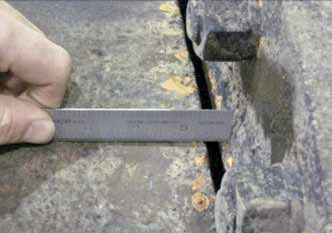 |
| Close-up of the broken pipe |
Background
The Power Plant’s Unit 4 “Alpha” circulating water pump was scheduled for repair. In the process of removal, the sister pump 4 “Bravo,” exhibited severe vibration and failed in a manner that was believed to have been a result of a broken shaft. The Alpha pump was put back into service and the Bravo pump removed and sent to the repair facility for inspection and emergency repair.
This circulating water pump performs a critical function in the power plant, by cooling the low-pressure steam in the condenser to use as feedwater for the boiler. A loss of one of these pumps in the summer means that the plant will not be able to produce to its maximum capacity until the pump returns to service.
Observed Pump Condition
The general condition of the Bravo pump when received at the repair facility was much worse than anticipated with the top column flange broken about half way around. The entire pump had been hanging from this broken joint leaving a gap of ¼ inch to ½ inch at the opening.
The keyed coupling (internal to the pump) used to join its two shafts was broken in several pieces. The shaft journals were severely worn to one side, and the impeller vanes and suction bell liner surface were also severely worn as expected, considering the significant pump damage.
After disassembly of the pump, the repair engineers also observed that the shaft enclosing tubes had spun in their fits because they were not fitted with any anti-rotation mechanism. This rotation caused damage to the O-ring fit areas at both ends of the enclosing tube assembly, which resulted in the loss of a proper flush water supply to the pump bearings below the packing box. Another issue observed during the inspection was that part to part alignment of major pump components used dowel pins, which are very difficult, if not impossible, to verify.
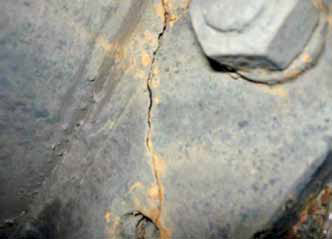 |
| Close-up of the broken pipe flange |
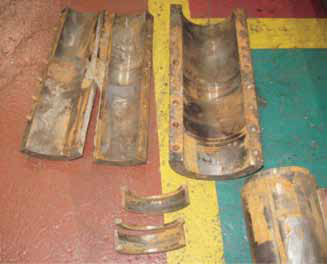 |
| Destroyed shaft coupling and hardware |
Opportunity for Improvement
While the typical repair scope of bearing, wear ring and small part replacement was employed, several issues identified during the inspection were corrected with improvement to the design:
- The column pipe repair included replacing the entire upper flange, adding reinforcing gussets to the flanges on both ends, excavating defective flange and pipe seams and full-welding to restore integrity and improve the overall strength of the column.
- Register fits were machined into each component as part of the repair process with minimum
clearance to assure proper alignment. - The impeller vanes were re-established to the proper and consistent vane lengths. This was done instead of merely de-burring the worn edges to restore pump performance and to eliminate hydraulic imbalance. It required an extensive amount of welding to the sealing surface of the vanes and precision machining of the impeller and suction bell because this fit has a significant effect on the pump’s efficiency. NDE of the impeller during inspection revealed minor cracks, which were also repaired.
- The repair plan required the replacement of both shafts, which presented another opportunity for improvement. The service center upgraded the shafts by manufacturing them in a stronger, more durable material to match the pump’s application. The improvements also included maintaining full-size shaft diameter through the coupling (the existing shafts were turned-down) and machining proper radii into all corners and keyways. A new upgraded coupling assembly was also designed and manufactured by the service center. The new coupling consisted of a larger outside diameter, heavier thrust rings (instead of the existing thin-walled clam-shell type), improved bolting and two keys, 180 degrees apart on opposite ends for balance and strength.
- Enclosing tube O-ring fit areas on both ends were restored, and the enclosing tube assembly was fitted with an anti-rotation device.
- Pump fasteners were replaced, upgraded to a more durable material to resist corrosion and fatigue.
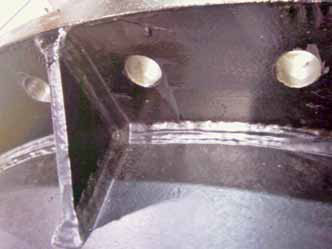 |
| Gusset added to the column pipe flanges |
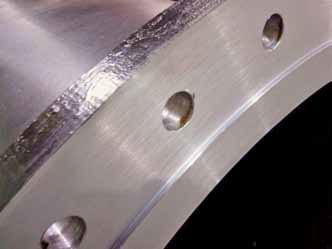 |
| Typical register fits added throughout the pump |
Follow-Up and Proof of Design
Repairs and modifications discussed in this article were completed on the Unit 4 “Bravo” circulating water pump in February 2010. Modification and repair of the sister “Alpha” pump was completed in December 2010, which outfitted the design of both pumps equally.
Soon after the completion of the Alpha pump, a traveling screen failure forced the removal of the Bravo pump once again.
Inspection revealed severe damage to the impeller by a piece of wood debris that was allowed to pass through the failed screens. This permitted an opportunity to inspect the repairs and modifications from the previous year.
The customer’s comments were: “In retrospect, after our most recent repair on this pump in January 2011, replacing the shafts was typically part of the repair scope. This is the first time I can remember not replacing the shafts due to the new robust shaft and coupling upgrade that was performed.” After the Bravo pump was repaired again and returned to service, he commented that: “The pump is currently operating as expected—quiet and smooth, ready for a long service life.”
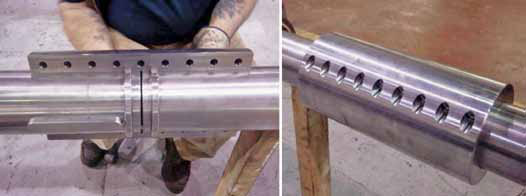 |
| New shafts and shaft coupling components during and after assembly |
Lessons Learned
While there are “typical” repair items such as bearing and wear ring replacement, shaft journal repair and impeller balancing, the unexpected issues are what really cause the most frustration.
Proper inspection will reveal other issues that may not be so obvious, and coordination with a qualified service provider can present real opportunities for improvement of your pumps. Improvement of pump reliability, durability and performance, provides greater mean time between repairs (MTBR), which is becoming the main focus of most pump users. The technical manager at the power station reports that working with his service provider has been a very positive experience to the power generating facility because the repairs are done right, pump inspection as-found and as-left measurements are documented and reported, and solutions to problems are identified quickly.
“At the power plant, we are good at burning coal and making electricity in a safe, reliable and environmentally responsible manner,” says the manager. “Hydro helps us do that by providing high quality pump repairs and delivering solutions on time. We are not experts at the plant in repairing pumps, but we know who to call, so we can get back to doing the things we are good at.”
Make sure to work with a qualified pump service provider who can offer a thorough inspection, engineering support and review and an experienced work force dedicated to providing a quality product.
Taking the time to review the current operating conditions in relation to the pump’s original design specifications can lead to engineering recommendations for improving the pump’s performance and extending its life.
Pumps & Systems, February 2012