



Babbitt Bearings
Babbitt bearings, frequently found in large steam turbines and generators in major power plants, can provide years of service if properly maintained. By using state-of-the-art technology and repair practices, aftermarket suppliers who specialize in Babbitt bearings can repair equipment and increase the life of Babbitt bearings by:
• Converting from lead to tin-based alloys, producing a strengthened bond and an increased bearing life
• Providing centrifugal casting, which can be a better alternative to static pours to strengthen the bond
• Converting from cast iron housings to steel, which creates a better bond and increases overall strength
• Enhancing machining practices and reducing need for hand scraping
Once a Babbitt bearing has been reconditioned, repair centers should quality check the bearings, ensure proper shaft clearances and oil relief, see that oil holes are sized per specifications and concentricity and that all parts undergo an ultrasonic inspection to ensure proper bonding.
To ensure a long service life, it is imperative during the casting process that new Babbitt material must be free from contamination and meet stringent specifications. Specific temperatures for both the Babbitt and bearing must be maintained to prevent the removal of tin, and oxidation to the shell. Specific revolutions per minute must also be maintained during the spin cast process. Other critical elements are good bonding of the Babbitt to the bearing shell, as well as proper outside dimensions, joint line contact and pin alignment. While Babbitt bearings are durable, like any bearings, they can eventually fail when operated in adverse conditions or when catastrophic occurrences occur within rotating equipment. The later is exactly what happened to one U.S. power plant during a typical business day.
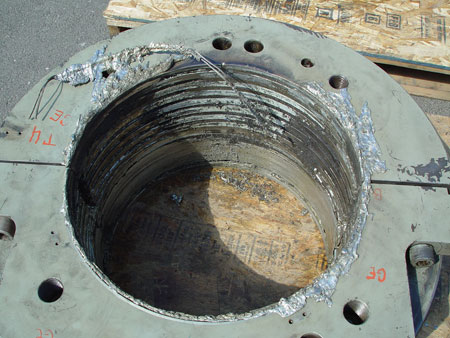
A damaged bearing after removal from the shaft.
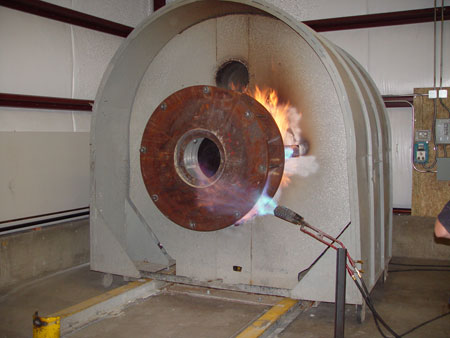
Centrifugal casting machine during a Babbitt repair
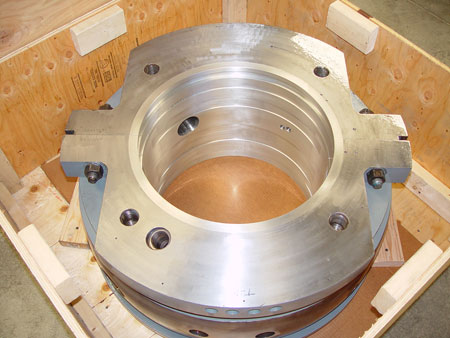
Babbitt after service and repair
Power Plant Reliability
Ensuring power is available for businesses and residents 24 hours a day is a challenge for any power generating entity. When one of the largest electric generation and transmission cooperatives in the United States experienced a problem with a turbine, an aftermarket supplier specializing in Babbitt bearings received the call for help.
The coal-fired power plant experienced a forced shutdown of one of its turbines. Through a series of simultaneous and unlikely events, both the primary and back-up oil lubrication pumps became inoperable, causing a loss of lubrication supply to all of the critical Babbitt bearings within the turbine and generator set. The loss of lubrication significantly damaged the turbine and generator Babbitt bearings.
Babbitt, like most bearing types, requires lubricant to reduce friction and remove heat from the bearing, rotating shaft and stationary housing. Babbitt bearings are a fluid film, or hydrodynamic, type of bearing, meaning that a fluid film of lubricating oil is required between the bearing surface and shaft. The oil film actually supports the shaft as it lubricates, reduces friction and removes heat. This bearing type is used in critical equipment because of its unique ability to handle high shaft speed and vibration. These unique bearings are also used for their imbeddability in the event impurities are present in the operating environment.
Immediately following the forced shutdown, the aftermarket supplier was one of the first companies put on standby to assist with upcoming repairs. Due to the potentially significant financial impact to the plant from lost production, the repairs required an around-the-clock effort to meet necessary deliveries and restore power generation capabilities.
Once the cooperative was able to fully assess the damage, it found significant damage to nine bearings, four of which ultimately required a complete rebuild of the bearing shells as well as rebabbitting; nine oil deflectors required rebuilding as well.
The most serious damage to bearings and deflectors came from the turbine journal contacting the bearing shell once it had worn through the Babbitt lining. The excessive heat buildup caused warping in all of the critical fit areas.
Restoring these bearings to a usable condition required a weld build up of the spherical bearing seat on the bearing outside dimension and stress relief of the shell, followed by the centrifugal casting of the Babbitt. In addition, prior to final machining, it was necessary to mill the split lines to restore flatness and re-drill and pin all of the alignment holes.
After repairing the bearing bore, the final restoration step was machining of the spherical bearing seat on the outside dimension of the bearing that had been welded previously. Because this critical surface must be exact in its size, the ball seats were finish machined on a CNC lathe, then hand-fit to their housings to ensure they met the OEM specifications.
Through the course of the repairs, the aftermarket supplier met all required delivery dates while upholding the high standard of quality required for this type of work. The project, from initial contact through completion, took approximately five weeks, requiring multiple overnight bearing shipments, which weighed up to three tons each. Most of the work was performed by Babbitt repair specialists in a centralized location; however, due to the extent of the machine work required, and the rush nature of the project, other resources and vendor partners were called upon to assist.
Pumps & Systems, February 2010