




Applications for electric power and the Smart Grid
For electric power operators, achieving efficient and reliable power delivery is crucial. Technological developments continue to guide the industry toward a smarter grid. One development is the implementation of communication networks in the electric grid. With the right communication network in place, a Smart Grid can reduce peak demand, shift usage to off-peak hours, lower total energy consumption and improve reliability.
However, the right communication system is different for each layer of the Smart Grid. At the distribution automation layer, for example, many actions are managed, such as demand for and control over the amount of electricity created/required versus the amount used/delivered to the use point. To effectively automate the distribution grid, a reliable communication network is required that balances speed, distance, security and ease of use.
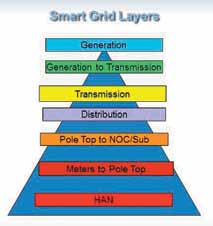
Smart Grid layers
Defining a Communication Network
A wireless communication network consists of broadcast points (transmitters) with receivers and transceivers where both fixed and mobile units can communicate with each other over broad geographic locations using radio waves. In the industrial world, including the Smart Grid, a communication network mostly will be comprised of fixed applications with a radio connected to a remote terminal unit (RTU), programmable logic controller (PLC) or some other intelligent device. Often, there is an input/output (I/O) device in the wireless network that communicates with a central location where the Supervisory Control and Data Acquisition (SCADA) network and telemetry is monitored and controlled.
Wireless Technologies for a Communication Network
No single wireless technology can satisfy the requirements and priorities of all applications, especially for a system as complex as the Smart Grid. The first step in determining which technology is the best choice for each layer of the Smart Grid is to evaluate what is most important to the operator in a communications system and what their individual needs are in advance. For some applications, reliability is critical. In the distribution layer, it is critical to have a highly reliable system with enhanced security features, accurate data and speed of data transmission.
Industrially-hardened wireless radios, including unlicensed frequency hopping spread spectrum (FHSS) and licensed frequency radios, are reliable in the harshest environments and are deployed daily in mission-critical industrial and military applications. At the distribution automation layer, they may offer the most reliable, economical solution.
For example, compared to fiber, wireless systems are easy to install. If a buried optical cable is damaged and requires repair or replacement, the costs can be high.
Some wireless systems provide information regarding pending maintenance concerns, and the location or type of maintenance required can be easily detected remotely. With this pinpoint information, operators send a technician out for service to the precisely right location if/when needed, saving time and resources.
If designed and installed correctly, wireless systems will last maintenance-free for years. Additionally, when compared to satellite and cellular options, certain wireless radio providers do not incur monthly fees that make satellite and cellular solutions more expensive over time. In fact, most comparisons show recurring data fees from cellular communications over a two-year period are equal to the cost of all devices for the same network with unlicensed FHSS radios.
FHSS radios also offer advanced security features that protect the Smart Grid from attack. For example, a major security concern is denial of service (DoS). In a DoS attack, an intruder accesses the network and blocks communication by crippling the network with excessive data. At this point, the utility no longer controls what is happening on the grid. This is dangerous and could cause a variety of risks, from a homeland security issue, to safety of the operators and teams of people working in the field.
It is critical to know whether the power is off in a certain area, if it is working in other areas and the high-level system view to keep workers and residents safe. At the distribution automation layer, FHSS wireless systems have proven to be very resilient to DoS by design. These wireless data radios use tiny amounts of radio spectrum at a time and will “hop” to another frequency quickly. Comparing this to standards-based radios (example: 802.11, Wi-Fi) which are available at electronics and retail stores, this makes a DoS attacks on FHSS systems difficult, if not completely impossible.
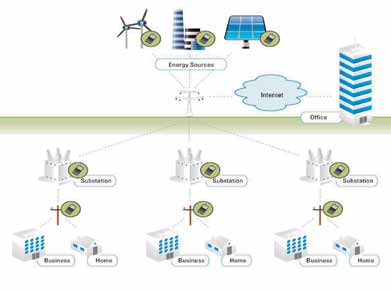
Smart Grid application
Monitoring with Wireless I/O
Also available for electric power operators are wireless I/O radios that use FHSS technology. Wireless I/O offers substantial and measurable cost savings in terms of engineering, installation and logistics as well as dramatic improvements in the frequency and reliability of field data collection.
In applications with a central processing device, wireless I/O enables users to extract full diagnostic data and predictive intelligence from the devices that then automatically notify the appropriate personnel of the precise problem before a costly asset, unit or plant shutdown occurs. I/O acts as the eyes, ears and hands of the wireless communication network whose overall goal is to deliver more value from the same assets.
As a result, wireless I/O is becoming increasingly popular to help reduce expenditures.
The majority of wireless I/O systems being deployed today are used for data acquisition, but increasingly more users are using wireless I/O in control applications. The electric power and Smart Gird markets, in particular, have many processes that can benefit from wireless I/O.
Wireless I/O for Power Transformer Monitoring
One example of a wireless I/O application in the Smart Grid is power transformer monitoring. Located in distribution substations and throughout the distribution grid, transformers critical. Transformers take extremely high voltages from power generation or transmission and decrease the energy level for proper distribution and delivery. This process is crucial for safe and efficient energy distribution to power homes and businesses. With extremely high power levels flowing through the transformers, it is often necessary to use a cooling system to prevent damage, most commonly using oil cooling. A damaged transformer is extremely costly to the utility and can cause power outages in the communities receiving power
With wireless I/O technology, this can be prevented. The capacity of oil to carry heat and cool equipment deteriorates with age. The breakdown is accelerated by heat. Transformers can generate immense heat, aging the oil. The greater the heat of the transformer, the faster the oil will deteriorate.
As aging occurs, the oil will quickly lose its ability to effectively cool. A wireless I/O can monitor the overall health of the transformer and cooling oil. Monitoring sensor outputs with wireless I/O devices, the operator has a clear view of the oil condition. New I/O expansion technologies allow the operators to monitor the oil condition at several places in large transformers by adding a stackable module to the wireless I/O radio. This allows the user to increase I/O points, without purchasing additional radios.
Wireless I/O can also monitor cooling fans. By using the digital input, operators can monitor whether the fan is actually working. This is another way to manage the extreme heat caused by energy that passes through the transformer. Furthermore, in locations in which transformer oil theft is pervasive, operators can be notified with real-time data when oil levels drop to service the site before more serious damage occurs.
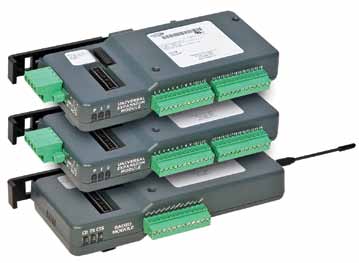
I/O Expansion
Wireless I/O for Variable Frequency Drives
Another unique application for wireless I/O in the electric power industry is control of variable frequency drives (VFDs). Pumps are used by electric utilities to store energy by pumping water uphill, and many utilities use pumps and wells to get fresh water for cooling and protection systems. To store energy, pumps force water uphill into a reservoir that is connected to a hydroelectric plant.
In the past, pumps have been controlled with on/off control, and the water flow has been controlled by restrictive valves to achieve the desired water flow. The valve caused energy loss because it dissipated energy that the pump consumed to push the water. The pump would still be running at full speed and consuming full power. The amount of energy put into the water dissipates in the valve because half of it is blocked, which becomes wasted energy. Newer installations have VFDs controlled by wireless I/O. VFDs adjust the speed and power control for pumps, delivering a specific amount of power to pump the right amount of water. This is more effective and efficient than turning on a switch, and it acts like a dimmer light switch. The operator can limit the amount of energy put into the pump and deliver just enough water. The amount of energy the pump uses then equals the amount of energy and water needed. This can save the utility thousands of dollars per pump.
Conclusion
Decision makers in the electric power industry continue to strive towards a grid that eliminates energy waste due to inefficient transmission and distribution systems. With the Smart Grid and all the supporting technologies, we can see these efforts in action. Wireless communication networks allow operators to become knowledgeable about the health of the grid. FHSS wireless data radios help decrease wasted energy and loss of power by sending critical data to an operator's fingertips.
Wireless I/O, in particular, can monitor and control critical electric power applications. However, decision makers must understand that communication needs vary from generation, to transmission, to distribution and from the pole-top to the meter to the home area network (HAN). The key to choosing the right technology at each level is to understand each system's needs before making a selection. Then developing a communication network that delivers the right benefits creates a smooth running system for efficient and effective power delivery.
Pumps & Systems, December 2011