




This article will review properties from two basic tests, how they are determined and what value they have in selection of sheet-gasket material for an application.
What Do These Properties Reveal?
The application for which the gasket is considered determines the importance of a specific property and what value might be considered good or acceptable. Many gasket properties are interrelated and often have to be considered together. A gasket with high compressibility might be desirable, but high compressibility might come with a material that has limited load capability. Considering this fact, some compromises might be required.
This article will review properties from two basic tests, how they are determined and what value they have in selection of sheet-gasket material for an application. Also under consideration are the limitations of the information insofar as a particular application is concerned.
ASTM F36: Test Method for Compressibility and Recovery of Gasket Materials
This test method determines two important, related gasket properties. The short duration test is performed at room temperature. The major load is applied for 60 seconds before taking the measurement for compressibility and the measurement of recovery is taken 60 seconds after removal of the major load.
Specific loads are applied to preconditioned specimens depending on the material type. This load is applied over an area defined by a penetrator to a gasket stress of 5,000 psi. The average of a minimum of three samples constitutes a test.
The results are calculated as follows:
Compressibility (%) = [(P - M)/P] x 100
Recovery (%) = [(R -M)/ (P - M)] x 100
Where:
P = Thickness under preload
M = Thickness under total load
R = Recovered thickness
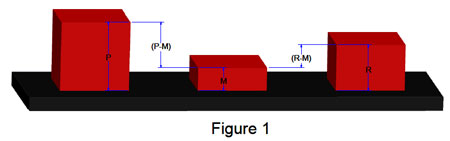
Figure 1. Compressibility and Recovery
How to Use the Results
This test provides some basic guidance for selection of a sheet-gasket material. The internal pressure, type, condition and load capability of the flanges are all factors that affect the amount of compressibility and recovery required.
Recovery is related to compressibility. The percent recovery is based on the amount the sample has been compressed under full load (P - M). This has to be considered in light of the percent compressibility. A low percent recovery value may have a higher absolute recovery than a material with a higher percent recovery, but a lower compressibility.
For example, consider one material, .062 in thick, which has 10 percent compressibility (.0062 in) and 20 percent recovery (.00124 in), and another material, also .062 in thick, which has 50 percent compressibility (.031 in) and 10 percent recovery (.0031 in). The material with 10 percent recovery will actually have a larger absolute recovery due to the differences in compressibility. Recovery measures the ability of a material with a specific compressibility to maintain a seal during the flange transitions encountered in service.
Since this test is conducted at room temperature and only measures short-time compressibility and recovery, it is not intended to measure these properties under application of prolonged stress at elevated temperature. It should be used in conjunction with the full range of properties relevant to a service application.
ASTM F38: Test Methods for Creep Relaxation of a Gasket Material
This test has two basic methods. The two terms, creep and relaxation, can be considered separately and in conjunction. Separately, they can be defined as follows. Creep is the loss of gasket thickness under constant load. If a compressive load were applied to a gasket sample of a given size, thickness would decrease. As the thickness decreases, the load would be allowed to remain against the gasket surface. The load would remain constant. This decrease in gasket thickness over time is defined as creep.
Relaxation is the measure of the loss in compressive stress under constant deflection. If a gasket were compressed to a defined thickness and the movement of the device applying the load fixed so that its position could not change, the change in the load over time would be a measure of the gasket's relaxation.
Creep relaxation is a combination of these two properties. A defined compressive load is applied to a sample material and the deflection or change in thickness is allowed to vary, while the applied load is allowed to decrease at the same time. Creep relaxation keeps the relationship between the change in gasket thickness and resulting change in load in a sort of equilibrium, much like one would see between the gasket and flange/bolt assembly in a bolted joint. As the gasket thickness decreases over time, there is a resulting decrease in bolt load.
Two test methods are described in ASTM F38, Method A and Method B.
Method A
This procedure is normally run at room temperature. The test device uses a calibrated strain gauged bolt (see Figure 2). During a controlled application of load applied at a uniform rate, strain readings are taken at defined intervals of time. These readings are then converted to a percentage of initial stress and plotted on a semi-log plot with the percentage of initial stress plotted against the log of time.
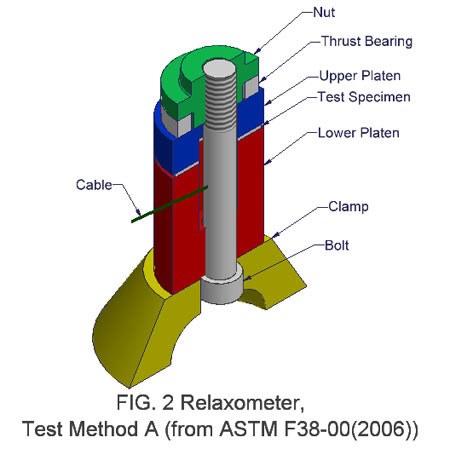
Figure 2. ASTM F38 Method A Relaxometer
Method B
This more common procedure also records loss of load over time, but uses a different relaxometer (see Figure 3) and can be performed at elevated temperatures. The device contains a removable precision dial indicator. The sample material is first compressed and then the dial indicator is removed and the loaded specimen placed in an oven at 212 deg F for 22 hours.
The specimen with the device is then removed from the oven and allowed to cool to room temperature. The dial indicator assembly is then reattached, and a reading taken. The difference in this reading and the initial reading is used to calculate the percentage relaxation as follows:
Relaxation (%) = [(D0 - Df)/D0] x 100
Where:
D0 = Initial dial reading
Df = Final dial reading
This basic test allows for a relative comparison of a gasket material's ability to maintain a compressive stress over time. A portion of torque loss on a bolted flange is the result of creep relaxation. Torque can also be lost by any number of other factors including bolt elongation, flange distortion and vibration. Elevated temperature also can intensify creep relaxation. When comparing values for creep relaxation for specific gasket materials, it is important to note which method was used.

Figure 3. ASTM F38 Method B Relaxometer
Conclusion
The values obtained by these test procedures enable relative comparisons of the properties important to gasket performance. They are not intended to accurately represent results under actual operating conditions. The data give the end user guidance on these material characteristics to compare with other products subjected to the same standardized tests. They also provide some degree of insight as to material suitability for a given application.
When reviewing test data for different materials, the conditions under which the data were generated should be related to a specific application. How do the operating temperature range and bolt load requirements for an application compare with the conditions of the standardized tests? What gasket thickness was used in the standardized test, and what thickness is considered in the application?
These tests do not cover the wide range of operating and load conditions a particular product might see in the field. These tests with others related to an application provide a starting point for selection of gasket materials for a specific application. The gasket manufacturer can best provide the collective set of test data needed to make that selection.
Adapted, with permission from F36 Test Method for Compressibility and Recovery of Gasket Materials and F38 Test Method for Creep Relaxation of a Gasket Material, copyright ASTM International, 100 Barr Harbor Drive, West Conshohocken, PA 19428.
Next Month: What fastener should I use for my bolted flange connection?
Pumps & Systems, June 2010
We invite your questions on sealing issues and will provide best efforts answers based on FSA publications.