Motors
How Online Vibration Monitoring Works E-mail
Written by Deane Horn   

Pumps & Systems, June 2007

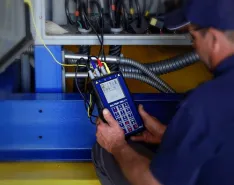
Why integrating vibration monitors with process controls provides fast response to pump faults, adds predictability and avoids unexpected shutdowns.

read more...
 
Protect Pump Motors with Simple Current Monitoring Techniques E-mail
Written by Pat Adamosky, Veris Industries   

Pumps & Systems, June 2007

In many pump installations, problems such as jams and suction loss can lead to serious damage to the motor or pump long before the thermal overloads trip. These problems can be quickly detected by monitoring drive motor current.

read more...
 
The Impact of Rewinding on Motor Efficiency E-mail
Written by Jim Custodio, GE Motors   

Pumps & Systems, June 2007

When a motor fails, users can (1) rewind, possibly for high efficiency; (2) replace the failed motor with a new motor; or (3) invest in a premium efficiency product. Here are the advantages and disadvantages of each approach and the precautions that must be taken to assure the best investment.

read more...
 
The End of Percussion Maintenance E-mail
Written by Mark Jermeay, Ingersoll Rand Fluid Technologies   
Pumps & Systems, June 2007 

Named for a technique commonly used on failing pumps, "percussion maintenance" - where a technician beats on the pump's stalled motor with a hammer or rubber mallet - often indicates motor deficiencies in his diaphragm pump. Though it is impossible for the maintenance department to predict when a pump will stall, such maintenance techniques are often the result of poor motor design.

read more...
 
Understanding Factors That Cause Shaft Failures E-mail
Written by Cyndi Nyberg, EASA   

Pumps & Systems, June 2007

Shaft failures do not happen everyday, but when they do, it can be a challenge to determine the cause of failure. Here's a technical explanation of what happens when the shaft bends or breaks.

read more...
 
Power Factor: Electricity Behaving Badly (Part One) E-mail
Written by Joe Evans, Ph.D.   

Pumps & Systems, June 2007

Most of the electric motor information we use on a daily basis is pretty straightforward. Voltage, amps, efficiency, and service factor are all well understood terms in our industry. There is, however, one motor characteristic that can be anything but straightforward. That characteristic is power factor (PF).

read more...
 
Power Factor (Part Two): Electricity Behaving Better E-mail
Written by Joe Evans, Ph.D.   

Pumps & Systems, July 2007

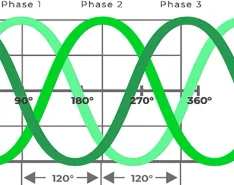
Last month we took a close look at the flow of voltage and current in purely resistive and inductive circuits. We showed how inductive reactance can inhibit the flow of primary current in a circuit and how this lagging effect determines the value of power factor (PF).

Although the purely resistive and inductive examples we used helped us understand what was happening, they do not represent a typical electrical circuit. Almost all circuits are a combination of resistive and inductive loads and, in some cases, those that are capacitive as well. Motors, arc welders, transformers, heaters, incandescent lighting, ballast lighting, solid state power supplies, and many other electrical devices contribute to the overall load on the circuit.

read more...
 
Confusing Units of Measure: Work, Power and Torque E-mail
Written by Joe Evans, Ph.D.   

Pumps & Systems, October 2007

Back in the early seventies, when I was in grad school, our government pledged to convert the U.S. measurement system to the metric system. A popular cartoon at the time showed a lab technician with a box of amputated human feet standing at the door of the supply room. The supply clerk was also holding a box, but his was full of volt meters. The caption was "Trading Feet for Meters." That was almost 37 years ago, and we still have most of those feet! I guess that I could say that we are still "inching" into the metric system.

read more...
 
Protective Relaying for Water & Wastewater Treatment Plants (Part One) E-mail
Written by Keith Robertson, P.E., Schneider Electric WWCC   

Pumps & Systems, October 2007

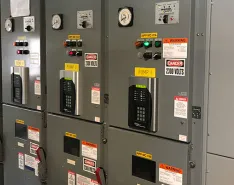
With highly reliable electrical systems, protective relays may be called upon to operate very infrequently. However, the effects of faults and abnormal conditions can be severe and protective relay systems must be designed carefully to protect against the worst possible fault conditions.

This article briefly describes the basic goals and philosophies behind relay system design and the types of protection that are applied in water and wastewater treatment facilities. As motors for pumping applications are particularly critical to water and wastewater facility operations, the major faults and abnormal conditions that affect motors are also covered. The relay schemes discussed here are typically applied to systems with operating voltages greater than 1000-V.

read more...
 
Hitachi America

Ruhrpumpen